The Ellis
Herbarium
A naturalist's approach to family history — organized not by birth order, but by the conditions that shaped each generation.
The Primary Lines
Three family lines, distinct in origin, converging in the American midwest across two centuries. Each arrived carrying something different: faith, trade, land hunger, a minister's education. What they passed forward was not wealth but movement — a pattern of going west.
A History of Movement
Every generation moved west. Not fleeing — moving toward. Land, faith, trade, and the American habit of beginning again. What follows is the route, with glimpses of the world each generation actually inhabited.
(Pernambuco)
Polhemus does not come to New Amsterdam directly from the Netherlands. He is first sent to Dutch Brazil — the territory around Recife and Pernambuco that the Dutch West India Company seized from Portugal in 1630 and held for twenty-four years. He serves as minister there for nearly two decades, preaching to Dutch colonists in a tropical colony that no one quite knows how to govern. In 1654, the Portuguese reconquer Brazil. The Dutch are evacuated. Polhemus boards a ship — not headed home to the Netherlands, but to the other Dutch colony on the far side of the Atlantic: New Amsterdam. He arrives an experienced colonial minister, already accustomed to the frontier.
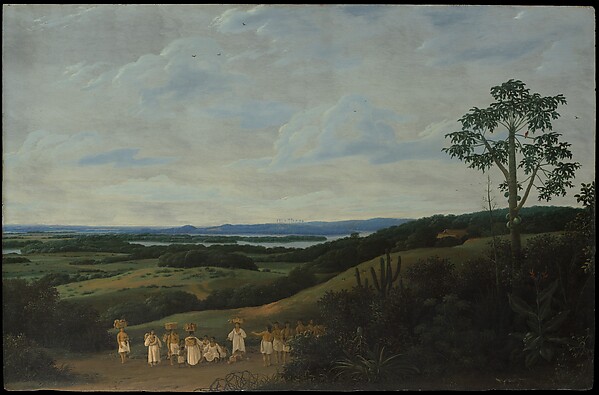
Dutch Brazil, 1650 — four years before Polhemus was evacuated. Frans Post was the official painter of the Dutch Brazilian colony, recording its landscapes, its sugar mills, its strange mixture of European governance and tropical heat. Polhemus lived inside this landscape for almost two decades. When he finally sailed for New Amsterdam, he had already been a colonial minister for half his career.
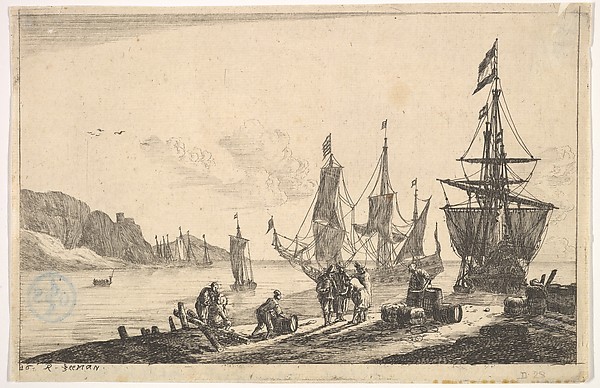
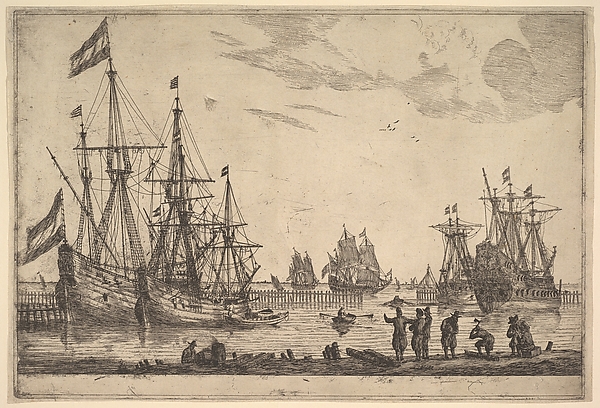
A Dutch vessel of the mid-1600s — the kind of ship that carried Polhemus from Brazil to New Amsterdam in 1654. Dutch maritime supremacy made these voyages routine for the company's employees. For Polhemus, it was his second ocean crossing. The Atlantic was, by now, familiar.
(now New York)
Johannes Theodore Polhemus arrives at New Amsterdam as one of only eleven Dutch Reformed ministers serving all of New Netherland — a territory stretching from Manhattan to Albany, with scattered settlements on Long Island and in New Jersey. University-educated, politically connected to the Dutch West India Company, he is part of the colonial intellectual elite — conducting services in Dutch, baptizing the children of merchants and traders, inspecting schools. His name, Latinized from the German "Polheim," marks him as a man of classical learning in a frontier colony where most people cannot sign their own name.
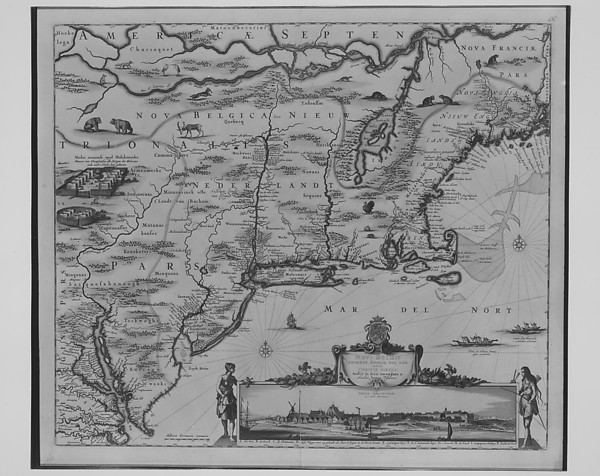
The Dutch cartographic record of New Netherland, made just two years after Polhemus arrived. The territory he ministered across — Manhattan, Long Island, the Hudson River valley — is shown here as the Dutch understood it in 1656. Ten years later, the English would take all of it and rename it New York. But in 1654, when Polhemus stepped off his ship from Brazil, this was still New Amsterdam, still Dutch, still a company town.
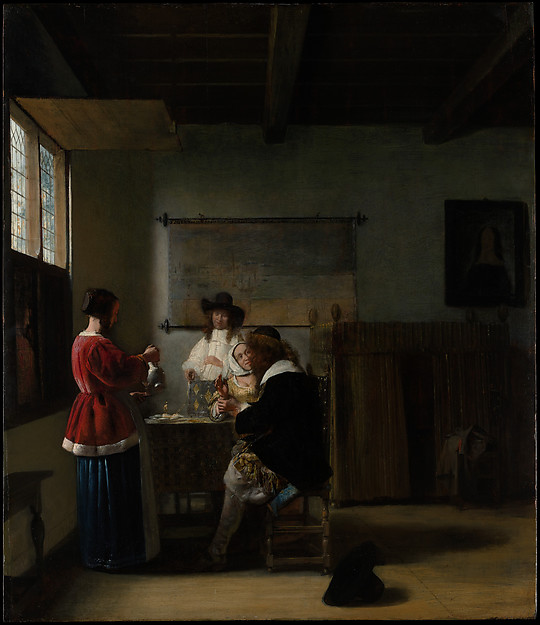
The domestic world of the Dutch Golden Age — tiled floors, daylight through leaded windows, the unhurried pace of merchant-class life. This is the world the Polhemus family carried in memory across two oceans: the Netherlands at its most prosperous and self-assured, producing more paintings per capita than any civilization before or since.
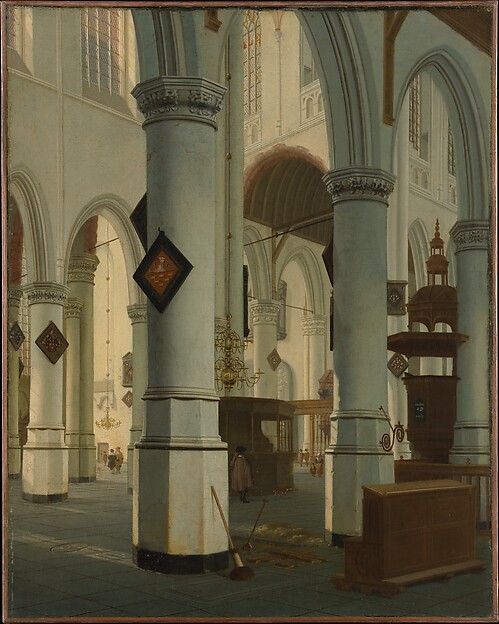
The whitewashed interior of a Dutch Reformed church — bare walls, high windows, plain wooden pews. No altars, no gilded saints. The Reformation stripped the church down to the word and the sermon. Polhemus preached in spaces like this, first in the Netherlands, then in Brazil, then in New Amsterdam, where the church was whatever building was available.
Pennsylvania
The family recorded as "Kunders" — later anglicized to Conard — arrives from Crefeld, a German town near the Dutch border where Quakers had found refuge. They settle in Germantown, Pennsylvania, and the first Quaker meeting in Germantown is held in their home. They are farmers and community builders, part of William Penn's experiment in religious tolerance and fair dealing. For decades, Quakers would govern Pennsylvania without executing a single member, maintain peace with native peoples, and build a colony that attracted other dissenters from across Europe.
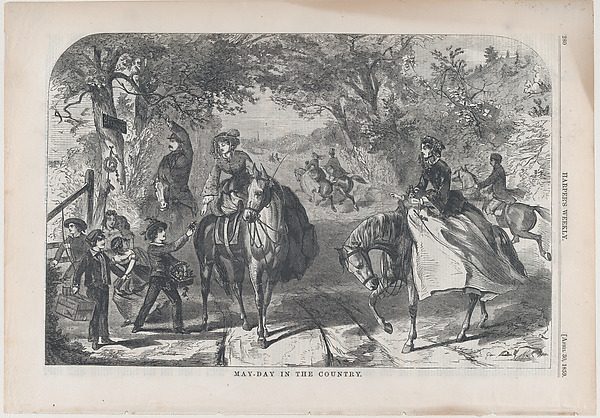
American rural community life — the rhythms of gathering, celebration, and neighborly work that characterized Quaker settlements in Pennsylvania and across the frontier. The Conards lived inside precisely this texture of shared life, where the community was both farm and faith.
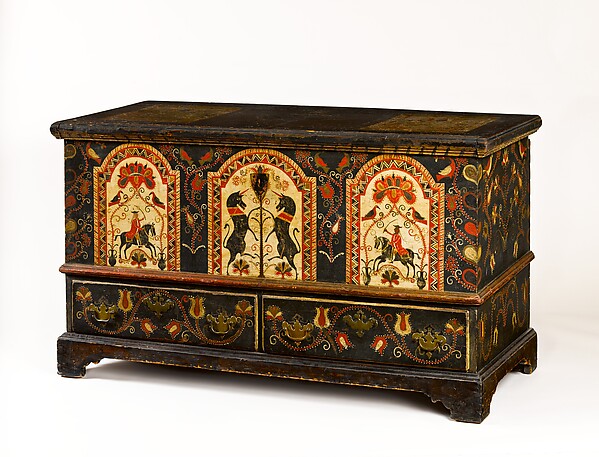
A Pennsylvania chest of the era — the kind of object a family carried with them from house to house, generation to generation. German immigrant families like the Conards brought their possessions in chests like this: Bibles, documents, clothing, the objects that said who they were when they couldn't explain themselves in English.
Somewhere in Maryland — likely Frederick County, a crossroads for Dutch, German, and English craftsmen — a Polhemus woman marries an Ellis man. Their son, born 1810, is given "Polhemus" as a middle name to preserve the connection. By the time census takers come to record him forty years later, they write what they hear: Plaemus. The Polhemus blood becomes a spelling mystery — the Dutch ancestor visible only to someone who knows what they're looking for.
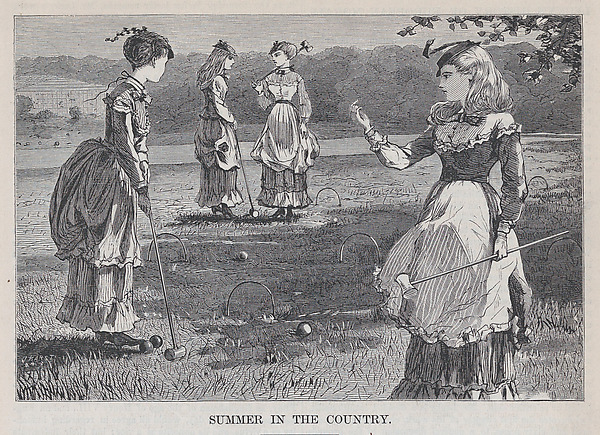
Maryland countryside — the wooded farmland, small towns, and craft trades where the Ellis and Polhemus families would have moved in the same circles. A Dutch name carried into a Welsh shoemaker's family. A marriage record we haven't found yet, in a county courthouse somewhere in western Maryland.
Ohio
John marries Eleanor Daniel in December 1834 and settles in Highland County, Ohio. By 1850 the census records him as a shoemaker with $2,000 in real estate. He is not a poor immigrant. He is a skilled tradesman who owns his shop and his home. The 1850 census shows five children in the house: daughters Hannah E. (14) and Isabella F. (12), plus sons John William, Joseph Matthew, and Mary C. (1). Samuel Edward Ellis — who will carry the family name into Indiana — is not born yet. John dies on his 67th birthday, who will carry everything into Indiana. John dies on his 67th birthday, July 2, 1877, in Hillsboro, Ohio.
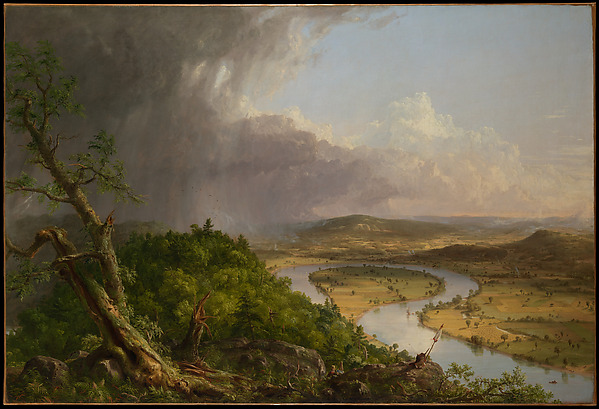
America in 1836: the sublime wilderness giving way to cultivated land. Ohio in the 1830s looked like this — half wild, half settled, the edge of everything still moving west. John Ellis arrived into exactly this landscape: fresh cleared fields, new roads, towns that didn't exist a decade before.
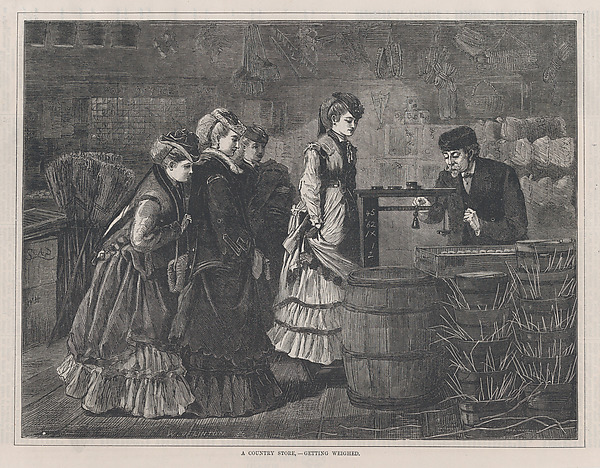
The American small town of John Ellis's era: the general store, gathered neighbors, an economy of trade and skill and reputation. A shoemaker with $3,000 in real estate was not a laborer. He was a craftsman with a shop, a clientele, and a name worth something in his community. Every pair of shoes was a contract.
War
While his father John Plaemus is still working as a shoemaker in Highland County, the oldest son — John William Ellis, born 1842 — enlists in the Union Army. His service record has not been pulled, so we don't know his unit, his campaigns, or what he survived. What we know is that he came home. And then, in 1873, at age 31, he dies of consumption — tuberculosis — the war's long-delayed casualty. Consumption killed more Civil War veterans than combat did. Whatever the war did to his lungs, or to him, he didn't outlive it by much. He is buried in Hillsboro, Ohio, four years before his father.
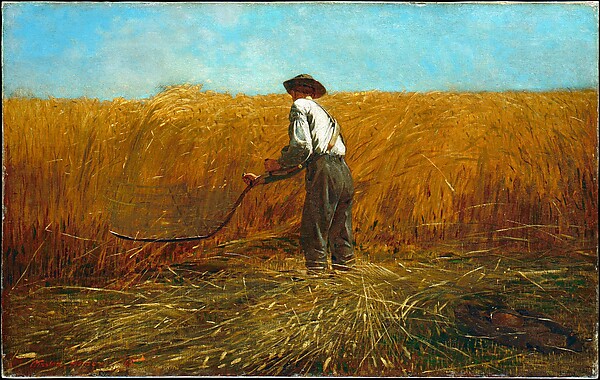
A Union soldier, just home from the war, harvesting wheat — his military jacket discarded on the ground behind him. Homer painted this in 1865, the year the war ended. John William Ellis came home to Ohio to something like this: the fields, the work, the ordinary life he'd left. He had eight more years.
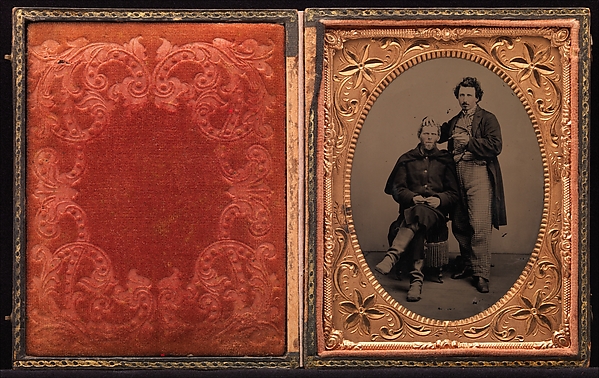
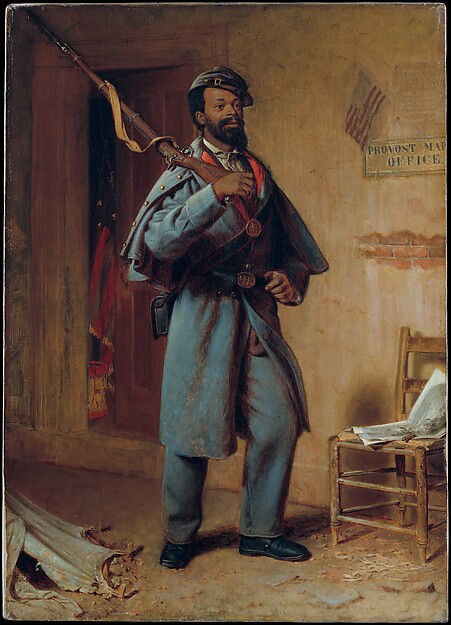
An actual photograph from the war years — a Union soldier sitting for his portrait, the way men did before they shipped out. John William Ellis would have had a photograph like this taken. It may still exist somewhere. His service record, if it survives, is in the National Archives.
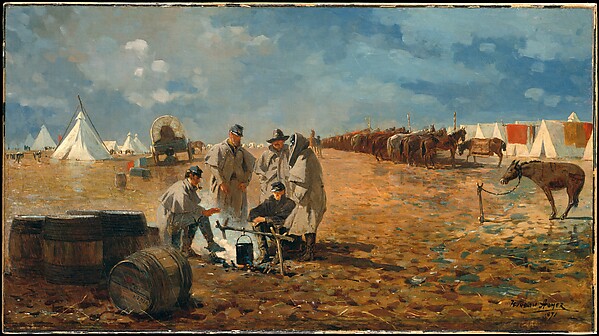
The encampment — the long stretches of nothing between battles that were, for most soldiers, the texture of the war. Disease, boredom, bad water, close quarters. Whatever consumption eventually found in John William's lungs may have started here, in a tent in Ohio or Kentucky or Tennessee, waiting for orders that never came fast enough.
Samuel Edward Ellis — son of the Ohio shoemaker, grandson of the Maryland mystery — marries Emma Conard in 1883. In this marriage, the Dutch Reformed minister, the German Quaker farmers, and the Welsh shoemakers become one family. Their son Benjamin Conard Ellis is born 1888. The westward movement, begun in 1654 when a minister boarded a ship in the Netherlands, has stopped. Indiana is where it ends.
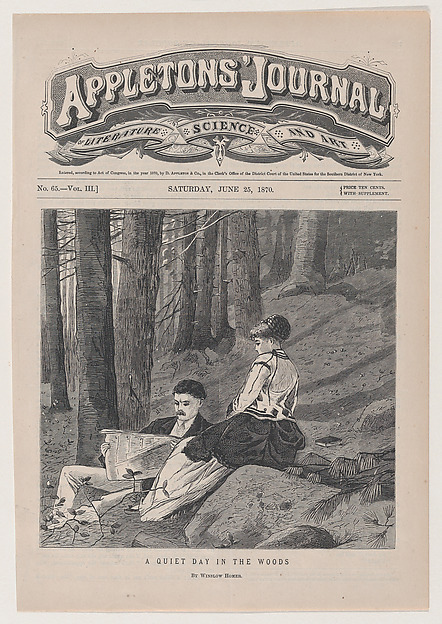
The settled American countryside — not frontier, not city, but the middle ground where the Conard and Ellis lines finally stopped moving. Indiana, 1883: a marriage, a farm, a family that has been traveling for two hundred and twenty-nine years and has, for now, arrived.
Objects & Evidence
What things survived. Maps that show the world before the English took it. A soldier's photograph. The kind of chest a family carried across the frontier. These are not your ancestors' objects — but they are objects from their world, of their type, made in their era. Close enough to touch.
The map of New Netherland
Nicolas Visscher's map of New Netherlands, printed around 1656 — two years after Polhemus stepped off his evacuation ship from Brazil. The territory shown here: Manhattan, Long Island, the Hudson Valley, the Connecticut River. The whale in the lower left. The beaver in the upper left — the fur trade that funded the whole enterprise.
In 1664, the English fleet sailed into New Amsterdam harbor and Peter Stuyvesant surrendered without a fight. Everything on this map was renamed. New Amsterdam became New York. New Netherland became New York Colony. But the Dutch families stayed, and some of them — including descendants of the Polhemus line — stayed for generations.
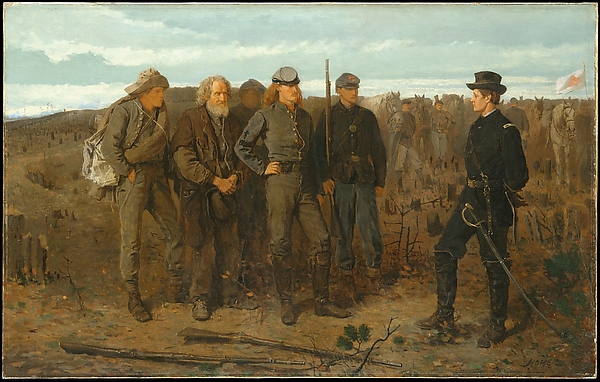
The People Register
Everyone confirmed so far — names, dates, and whatever the record actually says. Organized by line. The naming tradition alone tells a story: Conard as middle name, passed generation to generation, from a Quaker farmer's daughter through an Ohio shoemaker's family into Indiana and then Indianapolis.
Married: December 10, 1834, Elenor Daniel
Occupation: Cordwainer (master shoemaker); $2,000 real estate (1850 census)
Cordwainer vs. cobbler: A critical distinction. Cobblers only repaired shoes. Cordwainers made them from scratch — from raw leather to finished shoe. Colonial governments actually prohibited cobblers from making new shoes; only trained cordwainers could. The title required 5–7 years of apprenticeship. John would have kept wooden "lasts" — custom foot molds — for repeat customers, fitting shoes to individual feet the way a tailor fits a suit.
The reputation of the trade: Shoemakers were famously literate and politically engaged. The phrase of the era held that cordwainers were known for "remarkable intelligence." Captain John Smith of Jamestown was a shoemaker. American cordwainers formed the country's first professional guilds (Boston, 1648), ran exclusive social clubs (Philadelphia's Cordwainers' Fire Company, 1760), and sent 300+ participants to the 1788 Grand Federal Procession celebrating the Constitution — a deliberate "Buy American" statement against British imports. Their patron saint was St. Crispin; October 25 was the Shoemakers' Holiday.
Economic standing: $2,000 in real estate in 1850 = approximately $65,000–100,000 today. In Europe, a craftsman of his class could not own property at this scale — the guild system and aristocratic land ownership made it structurally impossible. He did it in Ohio, in one generation.
Buried: Hillsboro, Highland County, Ohio
1850 household (census): John (39, Maryland-born), Eleanor (listed as 25 — almost certainly a census error, she was ~38), Hannah E. (14), Isabella F. (12), John W. (8), Joseph M. (6), Mary C. (1). Samuel not yet born.
Previously unknown: Hannah E. (b. ~1836) and Isabella F. (b. ~1838) are daughters not in earlier records — discovered in the 1850 census image.
The name: "Plaemus" is the census taker's phonetic rendering of Polhemus — the Dutch surname carried as a middle name from a Maryland marriage not yet found.
Note: Died on his 67th birthday — born July 2, died July 2.
Died: December 13, 1886, Ohio (age 75, "old age")
Parents: James Daniels & Hannah [surname unknown]
Buried: Highland County, Ohio (Cemetery C, Section 99)
Note: Born in Illinois — unusual for this era; her family must have been early Illinois settlers. The Daniels line is completely untraced. Source: Highland County cemetery records PDF.
Parents: John Plaemus & Eleanor Daniel
Married: Anna McKibben
Service: Civil War veteran, Union Army
Cause of death: Consumption (tuberculosis), age 31
Buried: Hillsboro, Highland County, Ohio
Note: Died on his 31st birthday, four years before his father. Service record not yet pulled from National Archives.
Isabella F. Ellis: age 12 in the 1850 census, born approximately 1838
Parents: John Plaemus & Eleanor Daniel Ellis
Note: These two daughters were entirely unknown until the 1850 census image was reviewed. Nothing further has been found about them — no marriages, no later census appearances, no death records yet located. They were older than John William Ellis and would have been adults during the Civil War years. Their stories are a complete blank, waiting.
Died: April 2, 1931, Peoria, Illinois (age 74; buried Peoria)
Married: September 24, 1883, Emma Conard, Highland County, Ohio
Migration: Ohio → Peoria, Illinois (in Peoria City Township by 1900)
Children: Mary (1884), Eleanor (1886), Benjamin Conard (1888), Anna (1890), John Otway (~1892), William Edward (1895) — "at least 3 sons and 3 daughters" per FamilySearch
Note: Born in the same Highland County, Ohio as Emma Conard — they were very likely neighbors or community members before marrying. His parents remain the critical open question. FamilySearch shows 12 sources attached to his record; Ancestry shows him in 72 family trees.
Died: November 30, 1927, Peoria, Illinois
Buried: Peoria, Peoria County, Illinois
Parents: Benjamin Conard (1810–1902) & Elizabeth Conard née Hussey (1818–1913)
Married: September 24, 1883, Samuel Edward Ellis
Note: She is the reason the Conard name lives on. Her maiden name became her son's middle name, her grandson's middle name, and eventually her great-great-grandson's first name (your brother). Ancestry now shows a grave photograph for Emma Ellis — a headstone marked "ELLIS."
Parents: Samuel Edward & Emma Conard Ellis
Married: Hazel Slater Ellis (1891–1946)
Hazel's parents: William O. Slater (1864–1910) & Ida Mary Schmitt (1869–1945)
Son: Jack Conard Ellis (b. 1918, Peoria — one tree shows 1919)
Note: The "Conard" middle name tradition begins here — Emma's maiden name becoming her son's middle name. The pattern holds for two more generations.
Died: August 9, 2006
Parents: Benjamin Conard Ellis (1888–1960) & Hazel Slater Ellis (1891–1946)
Sibling: Phyllis A. Ellis
Married: September 1, 1945, Westminster Presbyterian Church, Peoria
Spouse: Margaret Lyall Day (January 24, 1921 – November 9, 2012)
Children: Dr. John C. Ellis (b. 1949), Dr. Richard L. "Dick" Ellis (b. 1951), Nancy Jane O'Brien (Living), Scott Robert Ellis (1955–1961)
Note on Scott: Scott Robert Ellis died in 1961 at approximately six years old — a child's death in the middle of the family's story, recorded now only as dates.
Mary (b. 1884, m. Henry Lottman 1917, d. 1960)
Eleanor (b. 1886, m. Harry Morgan, d. 1980)
Anna (b. 1890, m. Church Todd c. 1910, d. 1952)
John Otway (b. ~1892, m. Grace Truitt c. 1913)
William Edward (b. 1895, m. Marie Allton c. 1918)
These are your great-great-grand-aunts and uncles.
The Polhemus family is one of the best-documented Dutch lines in colonial America — traceable through church registers back to 1654. Their name lives on in the Ellis family only as a single phonetic misspelling: "Plaemus," written by a census taker in Ohio in 1850. Behind that misspelling is one of the most remarkable family origin stories in American history.
Origin: Netherlands, ordained Dutch Reformed minister
Role: One of only eleven Dutch Reformed ministers serving all of New Netherland
Languages: Dutch, Latin, and increasingly English — mastery of multiple languages was required for ordination and expected of all Dutch Reformed clergy
The name: Born with the family name Polheim (from the German/Dutch meaning roughly "house by the marsh or pool"). He Latinized it to Polhemus when he entered holy orders — a standard practice for university-educated clergy in the 1600s, signaling learning and religious vocation. The Latin ending made the name feel authoritative, classical, permanent.
Why he came: He did not come from the Netherlands directly. He had been serving as a minister to the Dutch colony in Brazil — specifically in Recife (Dutch Pernambuco), the sugar-rich colony the Dutch West India Company held for decades. In 1654, Portugal reconquered the colony after a long siege. The Dutch residents — including Rev. Polhemus — were given ships and expelled. His ship landed in New Amsterdam. He came to New York not as a planned immigrant but as a refugee from a fallen colony. He had already crossed the Atlantic twice.
His authority: As one of only eleven ministers in all of New Netherland, he held enormous religious and civic standing. Dutch Reformed ministers worked closely with the colonial government — Director-General Peter Stuyvesant was a church member. Polhemus performed baptisms, officiated marriages, maintained congregational records, trained other clergy, and traveled circuits to inspect schools. His records are the reason the family line is traceable at all.
Descendants: The Polhemus family spread through New York and New Jersey over the following generations before some branches migrated south into Pennsylvania and Maryland, where a Polhemus woman married into the Ellis family circa 1780s–1790s.
When Portugal retook the colony in 1654, Dutch residents were given passage out. Many sailed to New Amsterdam — among them, according to some accounts, the first Jewish community in North America (who petitioned Peter Stuyvesant for the right to stay). Polhemus arrived in this same wave. The fall of Dutch Brazil is the reason the minister who became your ancestor landed in New York.
Conducted services in Dutch until 1764 — over a century after the British took New Amsterdam and renamed it New York, the Dutch Reformed Church held its services in Dutch. Language was a form of cultural survival.
1766: The Dutch Reformed Church founded Queen's College in New Jersey — now Rutgers University. The Polhemus line is directly connected to one of the oldest universities in America, through the denomination that founded it.
Records: Because ministers like Polhemus kept meticulous baptismal, marriage, and burial records — sent back to Amsterdam for safekeeping — the Dutch colonial lines are among the best-documented of any early American family. The Polhemus family genealogy can be traced back to 1654 with confidence.
Her name has not been found. She is currently known only through her son's middle name. The Polhemus family is well-documented in New York and New Jersey; the task is tracing those branches into Maryland. Frederick County, Maryland — a hub of Dutch, German, and English craftsmen in the late 1700s — is the most likely search area.
Note on spelling variants: The same family name appears in records as Polhemus, Polhamus, Polemus, Polhemius, Polheymus, and — in your ancestor's case — Plaemus. All the same family.
Arrived: Germantown, Pennsylvania, 1683
Significance: First Quaker meeting in Germantown held in his home
Religion: Quaker (Religious Society of Friends)
Note: The original spelling was Kunders, later anglicized to Conrad/Conard. The family's records are well-documented through conardfamilyhistory.com going back to this generation.
Historical footnote — the first anti-slavery petition in America: In 1688, German Quakers in Germantown — the community Dennis Conrad/Kunders helped found five years earlier — signed the Germantown Quaker Petition Against Slavery: the first formal protest against slavery in American history, written in German and presented to the Monthly Meeting. It argued that enslaving people violated the Golden Rule. The Meeting tabled it (it was too radical for the time), but the document survived. It was rediscovered in 1844. Your ancestor lived in and helped build the community that produced it.
Died: November 7, 1902, Highland County, Ohio (age 92)
Buried: Penn, Ohio
Spouse: Elizabeth Hussey (1818–1913)
Daughter: Emma Conard (January 5, 1857)
Migration: New London PA → Highland County OH (before 1857)
Parents: Unconfirmed — Ancestry hint suggests Cornelius Conard (1764–1838) as father and Susanna Chalfant (1775–1862) as mother. These appear as "Potential" matches in Ancestry's tree hints; the LifeStory page currently shows "Unknown father / Unknown mother," meaning no one has confirmed or attached them yet. Given the timing and location — a Conard family in Chester County, Pennsylvania, Quaker community — the hint is plausible and worth pursuing. The New London Monthly Meeting records in Chester County PA are the place to look.
Note: Kate's 3rd great-grandfather per Ancestry. He lived to 92 — an extraordinary lifespan for the era, when average life expectancy (accounting for child mortality) was around 40, and reaching 60 was considered old age. Quaker communities had noticeably higher longevity, attributed to their temperance, plain diet, mutual aid networks, and lower stress from conflict avoidance. Benjamin's wife Elizabeth outlived him by 11 years, dying at approximately 95.
Quaker farmer standing: Pennsylvania and Ohio Quaker farmers were described by contemporaries as the "middling sort" — landowning, self-sufficient, community-respected, and morally authoritative. William Penn described Pennsylvania as "the Best Poor Man's Country": a place where an industrious farmer could own land, feed his family, and have standing in his community regardless of birth. The Quakers' reputation for absolute honesty made them preferred trading partners. Their Meeting Houses were the center of social life, dispute resolution, and welfare distribution. They cared for their own orphans, elderly, and poor — a parallel government of sorts.
Married: Benjamin Conard
Daughter: Emma Conard (b. 1857)
Potential father (Ancestry): Stephen H. Hussey (1775–1842) — flagged as "Potential" in Ancestry. The Hussey family was a documented New England Quaker line, which would fit the pattern perfectly — a Quaker woman marrying into the Conard Quaker family.
Note: If Stephen H. Hussey is confirmed, this opens a Hussey line worth tracing — New England Quaker families are exceptionally well-documented. Elizabeth lived to roughly 95, dying eleven years after her husband.
Separately, a Day–Conard marriage exists in the record: A. Lilly Conard (b. August 31, 1875) married Rev. Frank E. Day (August 25, 1894). Their documented children: Lilly Ann June (1895, died infant), Morris McCabe Day (b. April 12, 1900, m. Edna M. Burgett June 5, 1924), Harold Conard Day (b. 1903, died in childhood). Source: conardfamilyhistory.com.
Whether William Lyall Day is related to Rev. Frank E. Day — as a brother, cousin, or son — is entirely unverified speculation. It would be a notable coincidence if both "Day" men were unrelated, but coincidences happen. This requires direct research to confirm or rule out.
Died: November 9, 2012
Middle name: Lyall — named after her father, William Lyall Day
Parents: William Lyall Day (1891–1966) & Nellie Robilliard Day (1891–1978)
Siblings: Nancy Day (1925–2017), Dora Lucile Day, Sally Day (b. 1932)
Education: Manual High School, Peoria, graduated 1938
Work: Retail/office, 1938–1945
Married: Jack Conard Ellis, September 1, 1945, Westminster Presbyterian Church, Peoria
Family story: Spent time in a western state with her father during childhood/teen years; father had difficulty maintaining steady employment. Exact state unknown.
Spouse: Nellie Robilliard (b. 1891, d. 1978)
Daughter: Margaret Lyall Day (b. 1921) — named after him
Parents: William Worthy Day II (1869–1926) & Marian Inez Chambers (1873–1937)
Known: Took Peggy with him to a western state during her childhood/teen years (~mid-1930s); had difficulty maintaining steady employment; described as having a fiery temper
Note: The "Lyall" name passed from him to his daughter Margaret as her middle name. His father was "William Worthy Day II" — a named line going back further.
Married: William Lyall Day
Daughter: Margaret Lyall Day (b. 1921)
Parents: Walter H. Robilliard MD (1861–1931) & Eudora Joetta Hauser (1866–1944)
Father was a physician: Walter H. Robilliard held a medical degree — Nellie came from a professional family. This gives the Robilliard line additional documentation to search (medical licensing boards, hospital directories, professional registers).
Name origin: "Robilliard" remains likely French Huguenot or Swiss Protestant. Searching Walter H. Robilliard MD in medical records should surface his birthplace and origins quickly.
These names appear in the Ancestry tree with "Potential" markers — meaning Ancestry's algorithm suggests them as likely matches, but they haven't been confirmed through primary source research. Treat as leads, not facts.
If confirmed: Benjamin's father; would place the Conard line solidly in Pennsylvania through the Revolutionary War era — Cornelius was born 1764, meaning he lived through the Revolution as a young man.
Verify via: Chester County Pennsylvania Quaker records; New London Meeting birth records; conardfamilyhistory.com descendants list.
If confirmed: Benjamin's mother; the Chalfant name is itself a documented Quaker family of English origin in Chester County Pennsylvania.
Verify via: Chester County deeds, wills, and Quaker meeting records. Haverford College Quaker Collection.
If confirmed: Elizabeth Conard's father; the Hussey family was a prominent New England and Mid-Atlantic Quaker line. "Hussey" as a surname traces to Nantucket and Rhode Island Quaker communities — this could open a well-documented New England line going back to the 1600s.
Verify via: FamilySearch Hussey records; Nantucket Historical Association; Rhode Island Quaker records.
Verify via: Highland County Ohio records; 1850–1860 census for Schmitt households.
Emma Conard married Samuel Ellis in 1883, and her maiden name — Conard — became her son's middle name. Benjamin Conard Ellis (1889). His son: Jack Conard Ellis (1918). Four generations carrying the same word forward, each one a small act of remembrance for a Quaker farmer from New London, Pennsylvania, who lived to 92 and was buried in Penn, Ohio. And then your brother: Benjamin Conard Ellis, Indianapolis — the name returned to its beginning.
Sheryn's side of the family, arriving into the story through her marriage to John C. Ellis. The Seitz branch shows German immigrant ancestry; the Endicott name itself has deep American roots. Listed here for completeness.
Donna M. Endicott: born June 14, 1929; died November 30, 2004
Donna's maiden name: Seitz — confirmed on the handwritten family tree and her personal records. Walter Harold Seitz was her father.
Address: 1211 Short Drive, Pekin, Illinois
Children: Charles Jr. (b. September 5, 1948), Sheryn E. (b. October 17, 1949, m. Dr. John C. Ellis), Jamie/James C. Endicott (b. June 29, 1963)
Note on John C. Ellis: Donna's personal records list Sheryn's husband as "John M.D." — your father John C. Ellis held a medical degree.
Elizabeth L. Heflin: 1905–1978
Troy's parents: Samuel G.W. Endicott (1863–1941) & Nancy Allenton Hicks (1866–1931)
Elizabeth's parents: Melvin Curtis Heflin & [unknown]
Mary Jane Stallings: 1832–1913
Samuel's mother: Elizabeth Swanson (1795–1878) — a 4th great-grandparent, appearing in the tree without a confirmed father listed
Leona Pearl Reid: 1910–1990
Walter's parents: Frederick C. Seitz (1871–1951) & Minnie Albrecht (1877–1943)
Leona's parents: James Reid (1877–1954) & Eva L. Whitwam Reid (1886–1954)
Sophia Meir: 1845–1929
Photographs of both appear in the Ancestry tree — actual 19th century portrait photographs. Both names are solidly German. Frederick and Sophia were likely born in Germany or to German immigrant parents in America, arriving in the mid-1800s wave of German immigration. "Meir" is a common German Jewish and German Protestant surname.
The Research Map
Where to look next. Specific resources, specific search strategies, and the open questions with the best chance of resolution. Organized by priority.
SOURCES ALREADY FOUND
hillcem.weebly.com — Person File E →
conardfamilyhistory.com/descendants →
PRIORITY SEARCHES — IN ORDER
Search on FamilySearch (free): 1860 and 1870 Ohio census, Highland County. Look for a household with a boy named Samuel Ellis born ~1853. The head of household is your great-great-great-grandparent.
FamilySearch — Samuel Ellis Ohio 1860 census →
Search: Maryland State Archives, Frederick County marriage records, 1780–1800. Also search for Ellis families in the 1800 Maryland census — any household with a son born ~1810 named Ellis is a candidate.
Maryland State Archives →
FamilySearch — Frederick County Maryland records →
Search: FamilySearch for Robilliard in Illinois, Indiana, and neighboring states. Ancestry.com. WikiTree. The name's distinctiveness makes this potentially the fastest open question to resolve.
FamilySearch — Robilliard Illinois →
Search: FamilySearch 1920 census — "Lyall Day," Illinois. Then 1930 — same, but also check western states if not found in Illinois. His given name is unusual enough that false matches are rare.
FamilySearch — Lyall Day Illinois →
Fold3 — Civil War Union Service Records (paid) →
National Archives — Civil War Union Records →
FamilySearch — Chester County PA Quaker records →
Haverford College Quaker Collection (primary Quaker archive) →
FREE RESOURCES
familysearch.org →
Illinois State Archives death search →
peoriacountygenealogy.org →
wikitree.com/genealogy/CONARD →
peoriapubliclibrary.org →
FamilySearch — Highland County Ohio →
What the Record Keeps
Archives are not neutral. What survives says as much about power and institution as it does about people. The Quakers kept meticulous records, which is why we can trace the Conard line with confidence. The shoemaker's life is largely invisible, caught only in a census line and a graveyard.
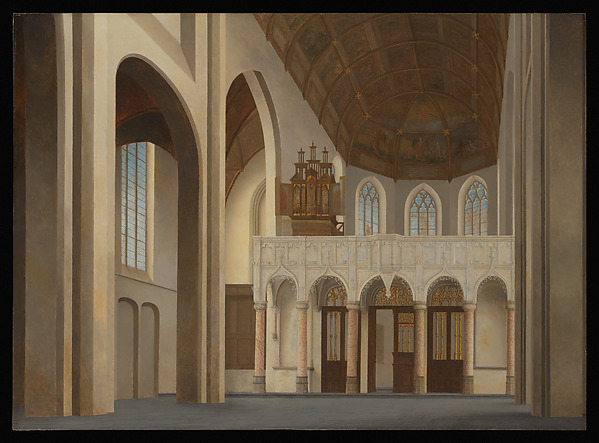
The church that kept the record
Dutch Reformed churches were systematic record-keepers — baptisms, marriages, burials, congregational rolls — because they understood documentation as a form of faithfulness. The Polhemus line is well-documented precisely because the Dutch Reformed church was literate and institutional. Every baptism Polhemus performed in New Amsterdam was written down.
The shoemaker left no such trail. What we know of John Plaemus Ellis comes from census takers who couldn't spell his name, a cemetery database, and a marriage record. The rest is silence — not absence, but erasure by ordinary inattention.
The World They Lived In
The facts behind the names. Each ancestor moved through a world with specific textures — what houses looked like, what work required, what historical events were unfolding around the kitchen table. These are the details that turn a family tree into a family story.
THE DUTCH LINE — NEW AMSTERDAM, 1654
THE QUAKER LINE — GERMANTOWN & OHIO, 1683–1902
THE SHOEMAKER LINE — MARYLAND & OHIO, 1810–1877
Field Notes
Good genealogical research generates more questions than it answers. What follows is the current list — the gaps, the mysteries, the things worth finding if they can be found.
COLLECTOR'S NOTE
Three hundred and seventy years of movement. Dutch ministers and German Quakers and Welsh shoemakers, all ending up in the same county in Indiana. They didn't know each other was coming. They didn't know they'd converge. But the records suggest it was almost inevitable — that everyone moving west eventually stops in the same place, and their children marry, and the whole complicated story becomes one family's story.